
A voided check is something many people need when setting up direct deposit, automatic bill payments, or linking a bank account.
If you have never written one before, the process may seem confusing at first.
The good news is that learning how to write a voided check is actually very simple and only takes a minute or two ✍️
When a check is marked “VOID,” it can no longer be used for payments, but it still contains important banking details such as your routing number and account number.
Companies and employers often request a voided check to verify banking information safely and accurately.
Many people worry about making mistakes or accidentally exposing sensitive details.
That is why it is important to know the correct way to void a check while keeping your information secure 🔒
In this guide, you will learn exactly what a voided check is, why it is needed, the correct way to write one, common mistakes to avoid, and alternatives you can use if you do not have checks available.
By the end, you will feel confident handling the process quickly and safely 😊
What Is a Voided Check? 🏦
- ✨ A voided check is a regular check with the word “VOID” written across the front ✨
- ✨ Writing “VOID” prevents anyone from cashing or depositing the check ✨
- ✨ The check still displays your banking information for verification purposes ✨
- ✨ Employers often request voided checks for direct deposit setup ✨
- ✨ Banks and service providers may also ask for one when linking accounts ✨
Why Companies Ask for a Voided Check 📄
- 💼 It helps confirm your bank account information accurately 💼
- 💼 It reduces the chance of payment errors or failed transfers 💼
- 💼 It is commonly used for payroll direct deposits 💼
- 💼 Utility companies may require it for automatic payments 💼
- 💼 It provides a secure way to share routing and account numbers 💼
How to Write a Voided Check Correctly ✍️
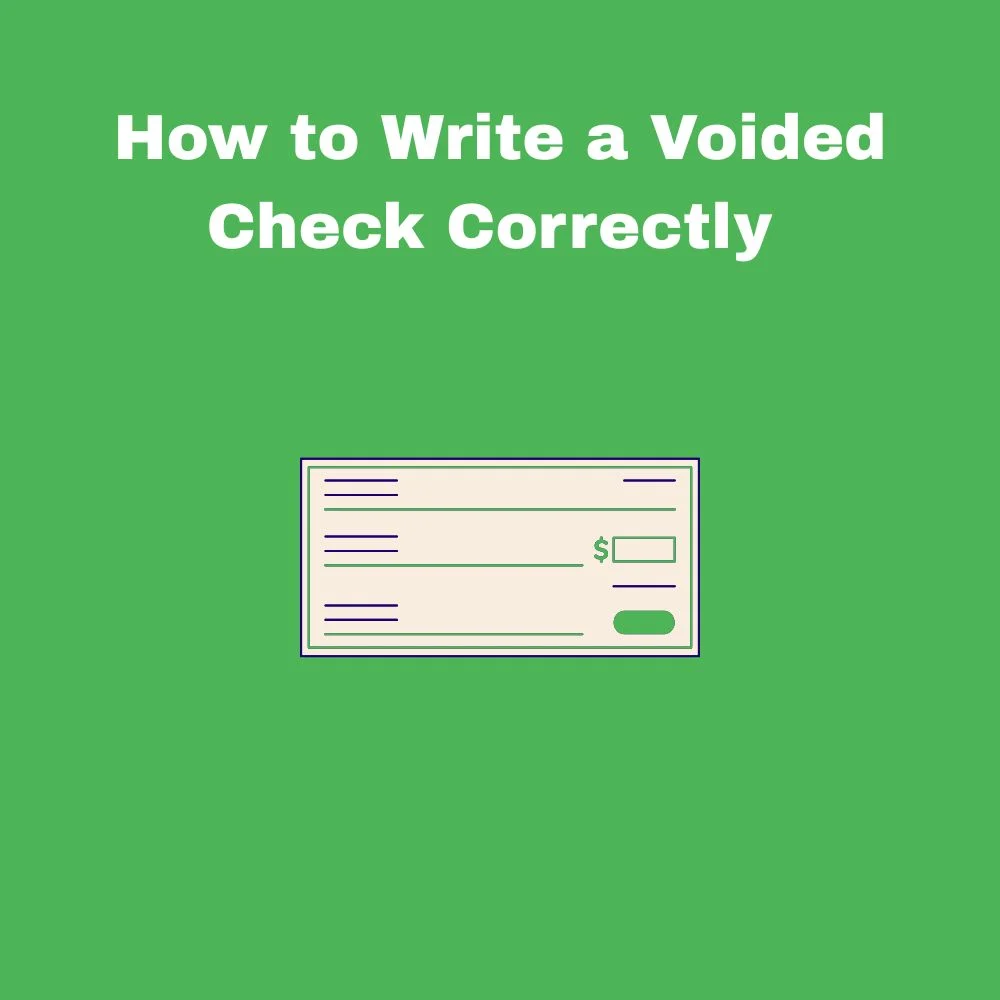
- 🖊️ Take a blank check from your checkbook 🖊️
- 🖊️ Use a blue or black pen for better visibility 🖊️
- 🖊️ Write the word “VOID” in large letters across the center of the check 🖊️
- 🖊️ Make sure the word does not cover the routing or account numbers 🖊️
- 🖊️ Avoid using pencil because it can be erased 🖊️
- 🖊️ Do not sign the back of the check unless requested 🖊️
Where to Write “VOID” on the Check 📝
- 📌 Write “VOID” across the payee line if desired 📌
- 📌 You can also write it in large letters across the entire front 📌
- 📌 Keep the bank details visible and readable 📌
- 📌 Make the text large enough so the check cannot be reused 📌
- 📌 Use clear handwriting to avoid confusion 📌
Common Uses for a Voided Check 💳
- 🌟 Setting up direct deposit with an employer 🌟
- 🌟 Linking bank accounts for online payments 🌟
- 🌟 Arranging automatic loan payments 🌟
- 🌟 Registering for government benefits 🌟
- 🌟 Establishing recurring subscription payments 🌟
- 🌟 Connecting payment apps to your bank account 🌟
Mistakes to Avoid When Voiding a Check ⚠️
- 🚫 Do not leave the check blank without writing “VOID” clearly 🚫
- 🚫 Avoid covering important banking numbers 🚫
- 🚫 Never hand out a partially completed check 🚫
- 🚫 Do not use correction fluid or erase marks 🚫
- 🚫 Avoid sharing voided checks with untrusted sources 🚫
- 🚫 Never throw away unused checks carelessly 🚫
Can You Void a Check After Writing It? 🤔
- ✔️ Yes, you can void a check if it has not been deposited or cashed ✔️
- ✔️ Write “VOID” clearly across the front of the check ✔️
- ✔️ Keep a record of the voided check for personal tracking ✔️
- ✔️ Inform the recipient if the original check is no longer valid ✔️
- ✔️ Contact your bank if you are unsure about the check status ✔️
Alternatives to Using a Voided Check 🔄
- 📱 A bank-issued direct deposit form may work instead 📱
- 📱 Some employers accept a printed bank statement 📱
- 📱 Online banking documents can sometimes replace checks 📱
- 📱 A pre-filled deposit slip may also be accepted 📱
- 📱 You can ask your bank for official account verification 📱
Is It Safe to Send a Voided Check? 🔒
- 🛡️ It is generally safe when shared with trusted organizations 🛡️
- 🛡️ Send copies only through secure channels 🛡️
- 🛡️ Avoid posting images of voided checks online 🛡️
- 🛡️ Store checkbooks in a secure location 🛡️
- 🛡️ Monitor your bank account regularly for unusual activity 🛡️
Tips for Protecting Your Banking Information 🏦
- 🔐 Shred old or unused checks before disposal 🔐
- 🔐 Review bank statements every month 🔐
- 🔐 Avoid emailing sensitive documents without encryption 🔐
- 🔐 Keep your online banking passwords strong 🔐
- 🔐 Contact your bank immediately if you suspect fraud 🔐
Conclusion 😊
Learning how to write a voided check is an important financial skill that can save time and prevent banking mistakes.
Whether you are setting up direct deposit, arranging automatic bill payments, or linking a bank account, a voided check provides a quick and reliable way to verify your financial information safely.
The process itself is simple. All you need to do is take a blank check and write the word “VOID” clearly across the front while keeping your account details visible.
Even though the check cannot be used for payments anymore, it still serves as an official document for verification purposes.
Understanding this small task can make many financial processes smoother and less stressful 😊
It is also important to stay cautious when sharing banking information.
Only provide voided checks to trusted organizations and always protect your personal details.
Secure handling of financial documents can help reduce the risk of fraud and identity theft.
By following the tips and steps in this guide, you can confidently prepare a voided check whenever needed.
With the right approach, the process becomes easy, secure, and hassle-free for everyday banking needs ✨

